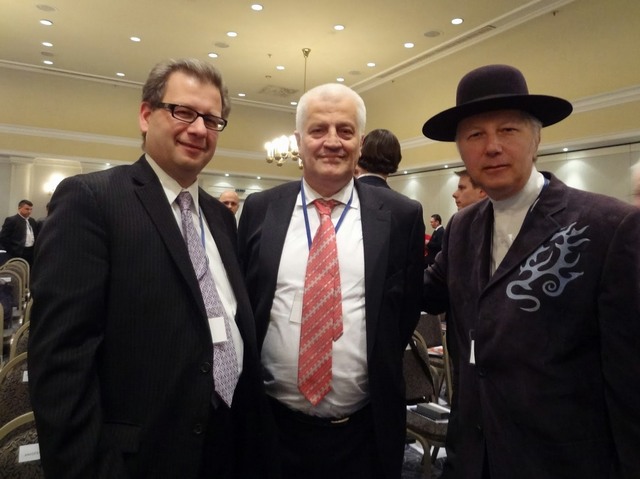
Established by Croatian law in 2012 and consisting of 55 representatives from around the globe
Joza Vrljičak in the middle, Croatian representative from Argentina,
with John Peter Kraljic (left) and Nenad N. Bach (right), Croatian representatives from the USA.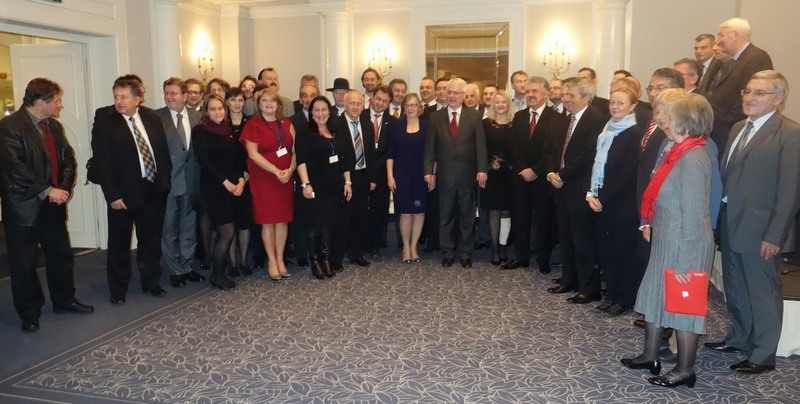
Meeting of the members of the Council with Mr. Ivo Josipović, president of the Republic of Croatia
CROATIAN GOVERNMENT ADVISORY COUNCIL FOR CROATS ABROAD
| Advisory Council for Croats Abroad – Report on its First Meeting CROATIAN GOVERNMENT ADVISORY COUNCIL FOR CROATS ABROAD – REPORT ON ITS FIRST MEETING 1. I returned recently from Europe where I participated in the First Meeting of the Advisory Council to the Government of the Republic of Croatia for Croats Living Abroad, which was held in Zagreb. 2. The Council was established by law in 2012 and it is formed by representatives of Croatians from around the globe. 3. We are 55 members proposed by Croatian communities in the different countries and nominated by the Government. 4. In the case of Argentina we are two members, that were elected in November 2012 by all the Croatian Associations and Groups in Argentina (more than 45). 5. There were 17 candidates and the most voted were magister Joza Vrljicak, editor-in-chief of the journal Studia Croatica and Mrs. Vjera Bulat Petrosic, president of the charity Caritas Croata Cardenal Stepinac. 6. They are Vice-president and President respectively of the Union of Croatian Associations in Argentina – Međudruštveni Odbor Hrvatskih Udruga i Ustanova u Argentini. 7. The other members of the Council for Latin America are Marco Buzolic B. (from Antofagasta) and Franco Ferrera Cvitanovic (from Santiago, who could not come to the Zagreb meeting) for Chile, Dubravka Sidonija Suto (from Sao Paulo) for Brazil, and Robert Jakubek (from Santa Cruz de la Sierra) for Bolivia, Paraguay, Uruguay, Peru, Ecuador and Venezuela. 8. Besides the 55 designated members representing the Croatians from all over the world, participated at the Meeting members by their positions (ex officio) representing the Academy, the Croatian Pastoral for Croatians Abroad, several ministeries, the National and University Library and several institutions that have to do with Croatian living abroad such as the Croatian Heritage Foundation (HMI) and the Institute for Migration and Ethnicity. And of course present at the Meeting were officials of the State Office for Croatians Abroad. 9. The Meeting took place in Zagreb on the 18 to 20th December 2013. 10. Wednesday the 18th started our activity with a visit to the Prime Minister of Croatia, Zoran Milanovic at his residence, in the Old Town (Gornji Grad). 11. Afterward we went to the Parliament of Croatia building –the Sabor, where we were received by his President, Josip Leko. There, a dinner was served. 12. On Thursday the activity started with the registration of the participants and then followed the Meeting itself. 13. Firstly addressed the Meeting the Director of the State Office for Croatian abroad, mr.sc. Daria Krsticevic. 14. In the second place spoke Mrs. Vjera Bulat Petrosic, who was presiding the session until the election of the President of the Advisory Council. Mrs. Bulat presided as the eldest member of the Council. 15. The next item on the agenda was the election of the President and the four Vice-presidents. The Law considers four groupings of Croatians outside the Republic of Croatia, namely: Croatians in Bosnia-Herzegovina, Croatian Minorities in countries near Croatia (some of these minorities have more than 500 years in these countries), the third grouping are the Croatians who live in Europe (recent migrations) and, finally, the Transoceanic Croatians), including those living in North and South America, South Africa, Australia and New Zealand. 16. For the position of President, two candidates were presented, one for Bosnia-Herzegovina (dr. Nevenko Herceg, professor and directive of the University of Mostar) and the well known musician and composer Nenad Bach, who lives in New York. 17. For the positions of Vice-presidents there were several candidates for the four grouping. 18. For the Transocean Croatian, the two most voted candidates in the first round were John Peter Kraljic (from New York) and Jose Maria –Joza- Vrljicak, from Buenos Aires. 19. Finally, after all the candidates addressed the Meeting to present themselves and to expose their ideas and proposals, the final voting took place, resulting in the following persons being elected:
Joza Vrljicak, M.A. |
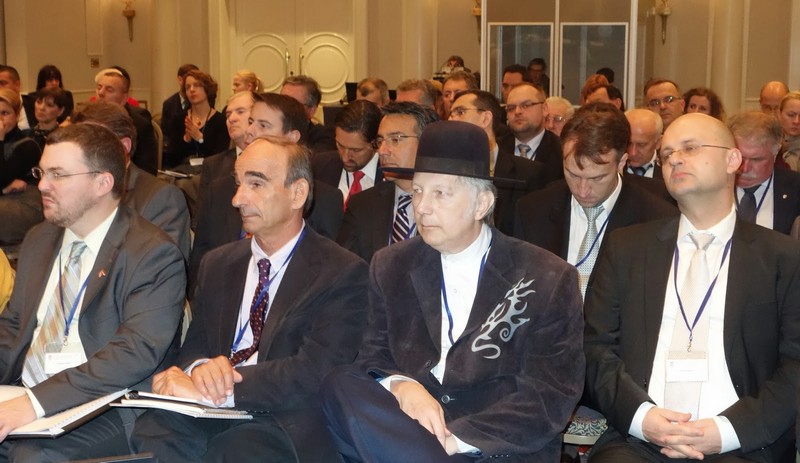

Croatian Deit, called Hrvatski SABOR, is one of the oldest in Europe.
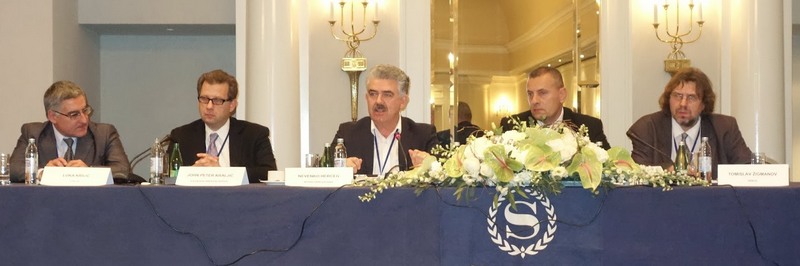
Luka Krilić, John Peter Kraljić, Nevenko Herceg, Ilija Nakić and Tomislav Žigmanov
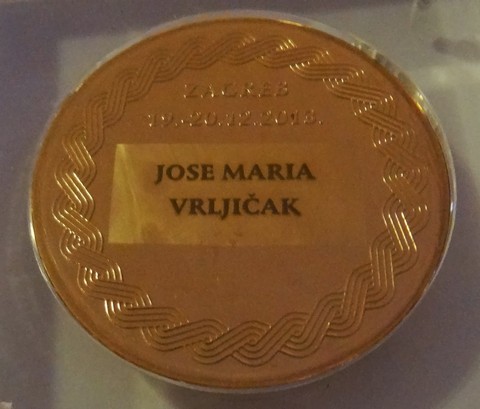
with his name encircled with an elegant circular old Croatian interlace pattern.
| Članovi Savjeta predstavnika Hrvata iz Bosne i Hercegovine
Članovi Savjeta, predstavnci hrvatske manjine
Članovi Savjeta, predstavnici hrvatskog iseljeništva / dijaspore
|
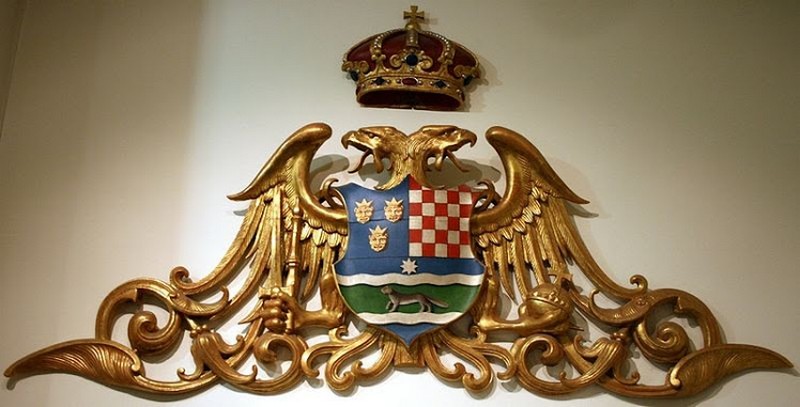
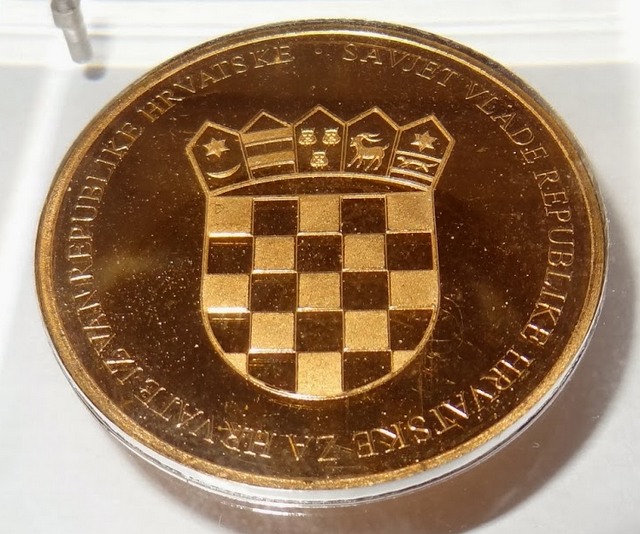
It represents the United Kingdom of Dalmatia, Croatia and Slavonia (Trojedna Kraljevina Dalmacija, Hrvatska i Slavonija):
three leopard heads on the left represent Dalmatia, to its right is the coat of arms of Croatia,
and below is the coat of arms of Slavonia, with kuna (marten) on the green surface.
The KUNA (i.e., HRK = Hrvatska kuna = Croatian Kuna) is the official Croatian currency,
the name of which was inspired by the usage of marten’s skin for paying since the 12th century.
The small star, visible in the middle, represents the city of Zagreb.

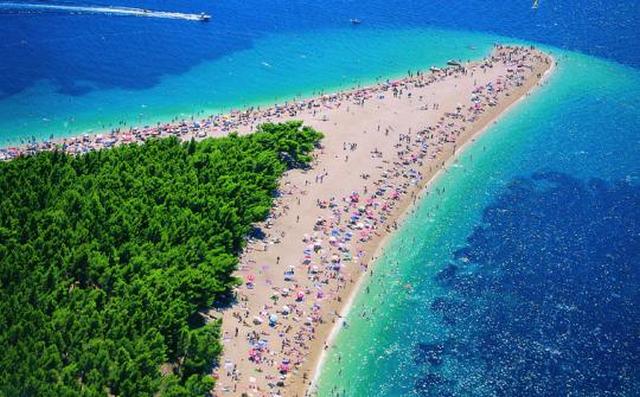
Note a parachutist flying to the beach.
| Welcome to the web site of State office for Croats Abroad Almost four million Croats live outside the Republic of Croatia. It is a huge and invaluable potential in human and economic terms. The adoption of the Act which provides the strengthening of mutual economic, cultural, scientific, educational, sporting and other links, and the establishing of the State Office for Croats Abroad sent a clear and definite message to all of you living outside the borders of our beautiful Homeland: We want to strengthen our unity, to build our cooperation on the principles of mutual trust and respect and to create partnerships based on institutional foundations. This is a tremendous step forward. Twenty years upon the gaining of Croatian independence the basic legal and institutional prerequisites are introduced in order to build the systematic and efficient cooperation where legal care for Croats abroad becomes a necessary part of internal and foreign policy, and the strategic objective is presented through the preservation, strengthening and development of the Croatian unity, as well as the economic and overall progress that includes Croats in the native land and Croats living in other countries. Given the fact that there are various situations of Croatian communities in the world expressing different needs and possibilities, the State Office for Croats Abroad, as the central government body for relations with Croats outside Croatia, will adjust its approach accordingly to each and every Croatian community with respect to their specific conditions. Furthermore, our intention is to strengthen Croatian communities abroad and their position and role in the societies where they live and work, and to provide conditions for their inclusion in the social and political life of the Republic of Croatia. I honestly believe that your additional support, your sincere engagement, motions and suggestions, even the well-intentioned criticisms will give a crucial contribution in achieving these set goals. Therefore I will use this opportunity to invite you once again for joining in constructive cooperation. The State Office for Croats Abroad will be the first address for all your needs, for all the good quality ideas and initiatives; we will give the strong support to all efforts which contribute to broad connections among Croatian people and will be the solid link and the bridge between the Republic of Croatia and you who live outside its borders. MSc. Daria Krstičević, Head of Office Source www.hrvatiizvanrh.hr Contact |
| Status of Croatian immigrants and their descendants abroad According to the census taken in April 2001 there were 4. 437, 460 inhabitants in Croatia. Based on the estimates and assessments of Croatian diplomatic missions and consular offices, Croatian Catholic missions, as well as the censuses taken in the countries where Croat immigrants and their descendants reside, and also based on the estimates of Croatian communities in some of those countries, it is estimated that there are about 3,000,000 Croatian immigrants and their descendants living outside Croatia and worldwide. Based on the assessments by individual countries around the world, the number of Croats and their descendants is as follows: Argentina: about 250 000 Australia: around 250,000 Austria: around 90,000 Belgium: 6 000 Brazil: around 20 000 Bolivia: 5 000 Chile: 200 000 Denmark: approximately 1 000 Ecuador: about 4000 France: 40 000 Italy: about 60,000 South Africa: around 8000 Canada: about 250 000 Luxembourg: about 2000 Netherlands: 10 000 Norway: about 2000 New Zealand: 40 000 Germany: about 350 000 Paraguay: 5 000 Peru: around 6000 United States, about 1.2 million Sweden: approximately 35 000 Switzerland: 80 000 Uruguay: 5 000 Great Britain: around 5000 Venezuela: 5 000 Source www.hrvatiizvanrh.hr |
Formated for CROWN by Darko Žubrinić
Distributed by www.Croatia.org . This message is intended for Croatian Associations/Institutions and their Friends in Croatia and in the World. The opinions/articles expressed on this list do not reflect personal opinions of the moderator. If the reader of this message is not the intended recipient, please delete or destroy all copies of this communication and please, let us know!


