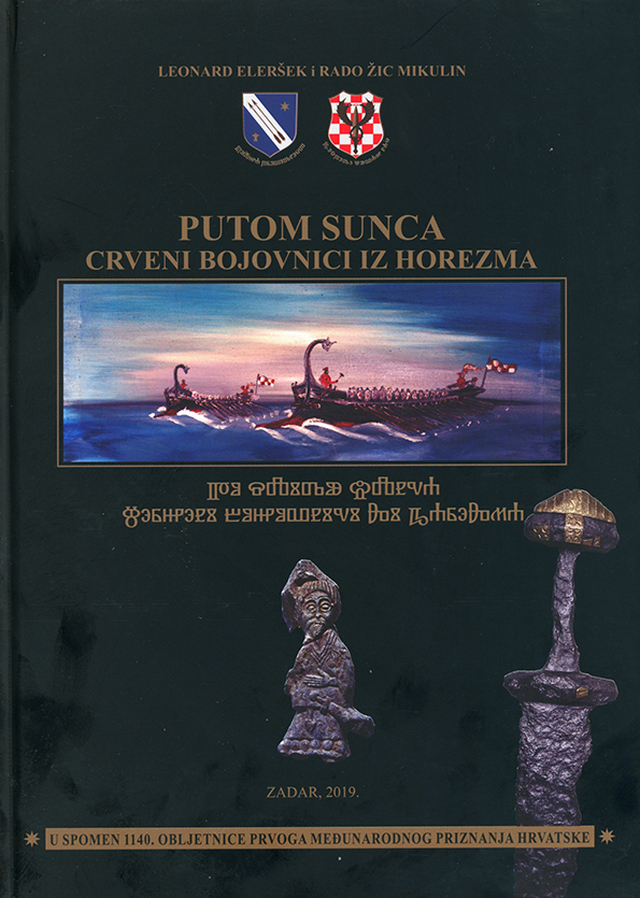
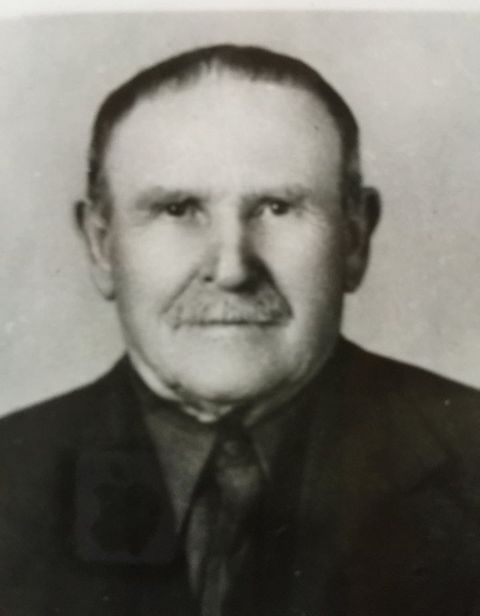
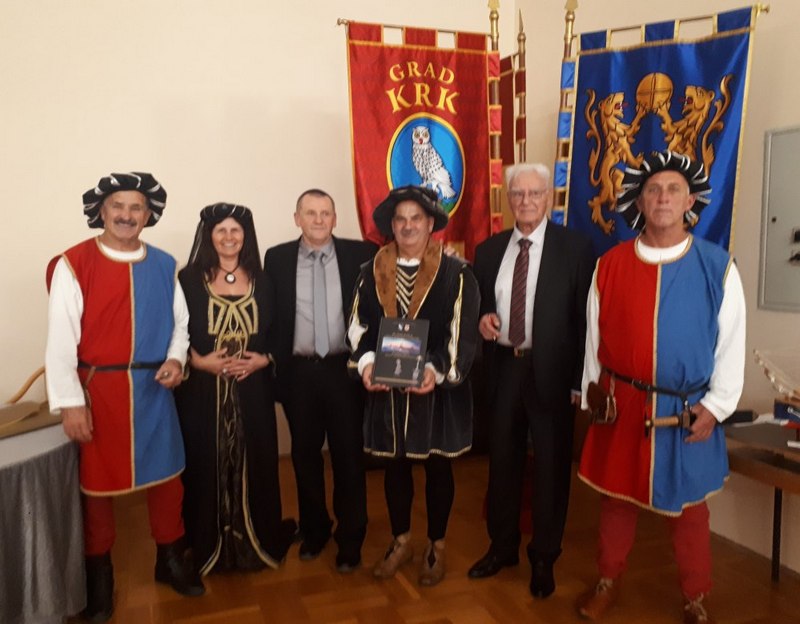
About the authors
Mr. Leonard Eleršek is a colonel of Croatian Air Forces. He completed his studies of Mechanical Engineering at the University of Zagreb.
Mr. Rado Žic Mikulin, PhD in Medical sciences, is a specialist in otorhinolaryngology and in cervicofacial surgery.
Generalities about the book
The book has 495 pp, and is of monumental format: 21 x 30 cm.
It consists of four chapters:
- Putom sunca (Following the Sun)
- Kravata, to smo mi (The Cravat – are We)
- Pjesme i priče otoka Krka (Poems and Stories from the Island of Krk)
- Dodatci (Additions)
The Foreword was written in two parts, by professors Ante Uglešić and Ivica Vigato (both of the University of Zadar). A flattering opinion about the quality and importance of the book was described by Tuga Tarle (p. 37), writer and former Croatian diplomat.
Croatian Glagolitic Script
Parts of the book use Croatian Glagolitic Script, mainly for decorative purposes; for example, headlines of even numbered pages are printed in the Glagolitic. The authors use the font created by Nenad Hančić, Duesseldorf (his name should be mentioned in the new edition of the book). On p. 44 we can see a part of the folk poem Frankopan’s feast, handwritten in the Croatian Glagolitic.
Language of the book
The saga is contained in Chapter 1, on pp. 78-263 of the book. The original čakavian text is contained on even numbered pages, while the corresponding contemporary Croatian text (štokavian) is placed on odd numbered pages.
Poems and Stories from the Island of Krk (Chapter 3)
This chapter is quite important. It reveals till now unknown folk stories dealing with various historical events during Croatian history. We mention a few of them (out of 21):
- Puntarska noć (Puntar night)
- Zauzeće Zadra (Occuption of Zadar)
- Bitka kod Lepanta (War at Lepant)
- Jurjeve Stijene (George’s Rocks)
- Sv. Lucija (St. Lucy)
The poem St. Lucy mentions the precise year 1080 (in 11th century) as the year when the benedictine Abbey of St. Lucy in Jurandvor near Baška on the island of Krk was completed, as well as the Baška Tablet.
The authors announce that by the end of 2020, a much more extensive book dedicated to Croatian folk stories will be published, containing approximately 800 pages!
Terminology
The reachness of the chakavian language is amazing. Chakavian literature (written in Latin, as well as in Glagolitic scripts) is a backbone of Croatian literacy, going back to Middle Ages (the most distinguished representative is Marko Marulić), and living also today.
Pictures
The book is interspersed with numerous pictures and figures. Especially interesting are those referring to Croatian mariners and old ships.
Maps
On pp. 264-275, we can see various old European maps (some of the reproduced in color), from which one can see the travel of Croatians to their new homeland – the present day Croatia at the Adriatic coast.
Additions
The authors made a great effort to include a short descriptions of relevent notions appearing in the book. This is not just an Index of Notions, but also a small lexicon, helping the reader to better understand the rest of the book. Futhermore, a short presentation of scholarly studies of two scientists is included:
- professor Aleksandar V. Mayorov (of the University of St. Petersburg, Russian Federation, who published an important monograph Great Croatia in 2006, in Russian)
- professor Orest Korčinski (of the University of Lviv, Ukraine, who published important studies about the Stiljsko complex south of Lviv, in Ukrainean language).
Summaries
The book has summaries in as many as six languages: Croatian, English, Ukrainean, German, French, and Japanese.
Publisher
The book was published by Matica hrvatska (Matrix Croatica) in Zadar.
Purchasing the book
Those interested in purchasing the book may write to the first author, Mr. Leonard Eleršek: eler.zadar.hr@gmail.com
Congratulations to the authors and to the publisher for very fine work!