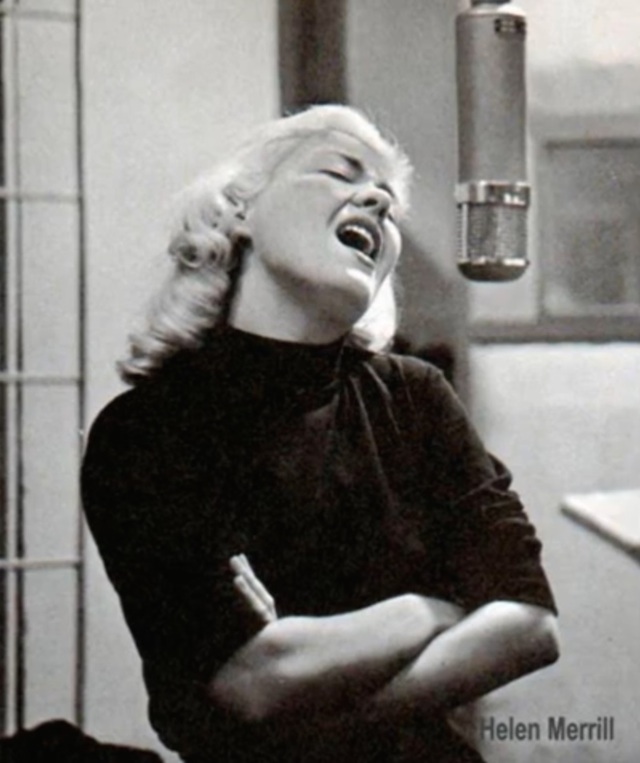
Joao Moreira dos Santos: Helen Merrill is one of the most distinctive jazz singers ever
Helen Merrill – You’d Be So Nice To Come Home To – live 1960.
Festival de Jazz d’Antibes, Juan-les-Pins, France, July 1960.

| Helen Merrill – excerpt from an interview I never had a singer as an idol. I listened to many musicians and my idols were [saxophonists] Ben Webster, Lester Young, Johnny Hodges. These people knew the lyrics of the songs and interpreted the music with the meaning of the song in mind adding their own special feelings. My mother was my real influence. She felt music from a very spiritual place. A private place that was all her own. This kind of music can have no teacher – it came from her birthplace which was the island of KRK in Croatia. From that, I permitted my own experiences to lead my interpretation of music. I do not believe that art should emulate or we would still be looking for clones. We learn from one another and from there go on our own journey. 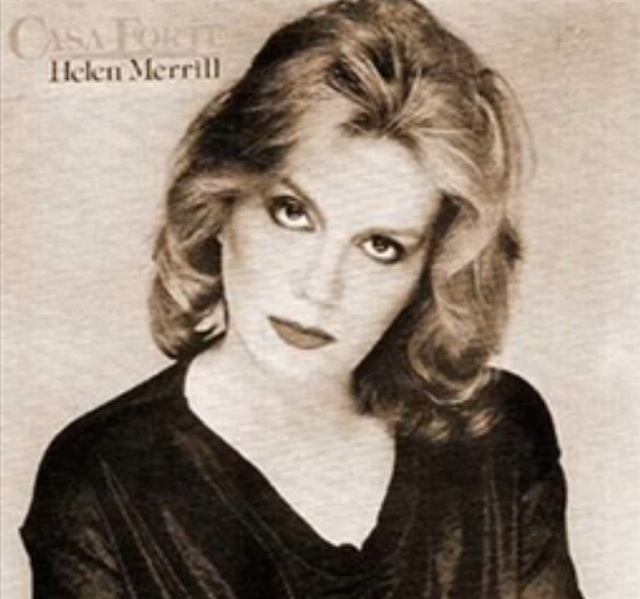 Helen Merrill
I learned that spaces and the imagination of the listener were as important as the messenger. There are lines in “I’ll Take You Home Again Kathleen” to this day I feel deeply moved by: “The roses all have left your cheeks, I watched them fade away and die… your voice is sad when e’re you speak and tears bedim your loving eyes, Oh I will take you home Kathleen to where your heart will feel no pain,” etc. – it was clear to me my mother was singing about herself. My mother missed her homeland and family there. Helen Merrill aka Jelena Ana Milcetic  The singer (who was 68 and 69 when this CD was recorded over a five-month period in 1999) learned a lot of about Croatian culture from her parents, and by calling this release Jelena Ana Milcetic, she is celebrating her heritage. But the album is also a celebration of Merrill’s American heritage. By housing jazz, pop, folk, and Croatian elements under the same roof, the New Yorker acknowledges her parents’ homeland as well as her U.S. upbringing. This isn’t a release that caters to jazz purists — although some of the material is very jazz-oriented (especially Merrill’s interpretations of “Among My Souvenirs” and “Lost in the Stars”), some of it falls outside of jazz. Jelena Ana Milcetic a.k.a. Helen Merrill is a 2000 studio by Helen Merrill. The album is a tribute to Merrill’s Croatian heritage.
|
Helen Merrill With Gary Peacock Trio – Until It’s Time For You To Go (Japan, 1971)
RECORDINGS ARE RECORDED DIRECTLY FROM THE VINYL TO CD AND NO NOISE CANCELING PROGRAM IS USED.
SIDE B TRACK 4 . BAMBOO FLUTE : HOZAN YAMAMOTO.
Helen Merrill in Japan
 Helen Merrill in Tokyo
 Helen Merrill: Big in Japan, JazzTimes, 2018 (updated in August 2024 by James Gavin)
As for Japan, Merril says, “I might go back for one more sayonara” 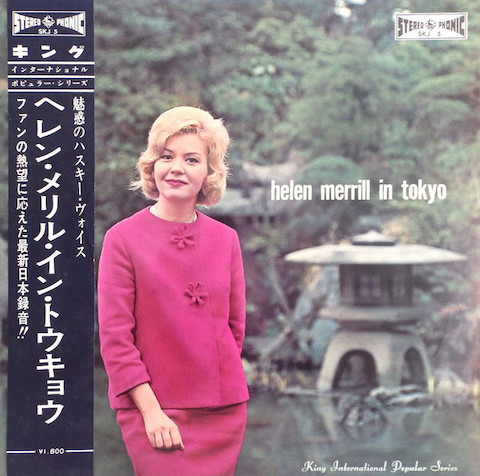 Helen Merrill Live In Japan 1990 (at the age of 60)
Motherless Child – Helen Merrill in Tokyo & sings folk (1963, at the age of 33)
 Helen Merrill’s parents
 are from Croatia, both of them born on the island of Krk: her father (Frano Mileetiae) was born in the village of Vantaeiaei, and her mother (Antonija Marija Mileetiae) in the town of Malinska.
Her mothers’ maiden name was Antonija Marija Mileetiae (yes, Milčetić; sic!), born in the village of Bogovići in Dubašnica, 16th November 1901. She was baptised in Duba1nica in the Church of St. Apolinar, which was not far from her home. Her mother (Hellen’s grandmother) was also Antonija Mileetiae b. Turčić, and her father – Juraj Milčetić.
Hellen’s parents – Frano and Antonija Marija, they met in New York and got married there.
Many thanks to Mrs. Dorothy Milcetic, sister of Helen Merrill, for this information (based on krsni list, that is, baptismal certificate, of her and Hellen’s mother).
|


| I read a comment Helen made about our mother Antonette, singing out her pain. My parents lost their first born son Johnny at 6 years old in a horrible and tragic accident. My mother actually never recovered from it and turned to religion and other things to ease her pain. We girls were not yet born except for Margaret who witnessed the tragedy. My mother missed her mother and father but returning to visit in those days was impossible. No flights and long expensive ships. One of the songs that haunts me that she sang was an Irish song, I’ll Take You Home Again Kathleen. The words are very poignant for all immigrants. The other song was, Danny Boy also Irish. Helen was very much influenced by our mother in her interpretation in singing. Dorothy Milcetic |
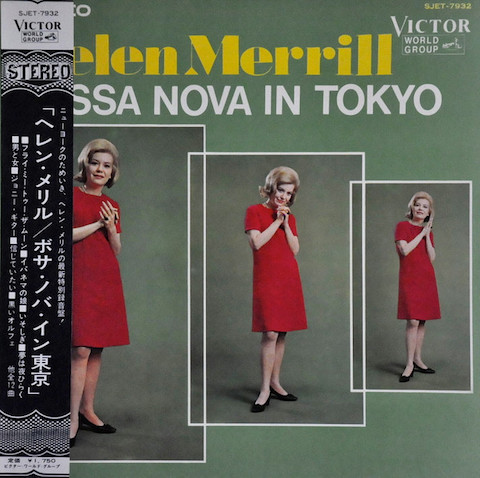
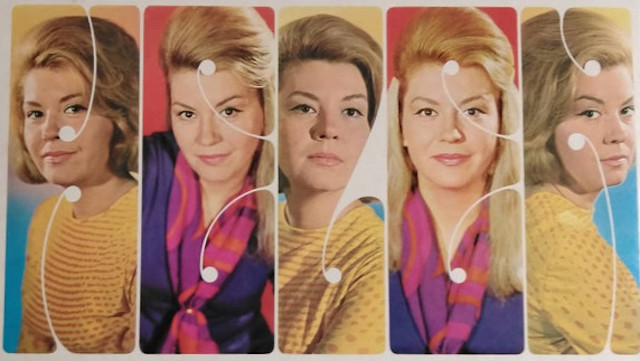
Anna was a model in New York for several years, before she married a Brazilian and moved to Rio.
Information and photo by the courtesy of Dorothy Milcetic.


| “Helen Merrill” – A Timeless Debut in the Jazz Pantheon Introduction: In the vibrant tapestry of jazz history, certain albums stand as markers of brilliance, encapsulating the spirit of an era. Helen Merrill’s eponymous debut, recorded in December 1954 and released in 1955, is undeniably one such masterpiece. This article explores the richness of Merrill’s inaugural venture into the studio, her collaboration with trumpeter Clifford Brown, and the enduring impact of an album that seamlessly weaves together cool jazz and hard bop. A Pioneering Collaboration: Merrill and Brown Helen Merrill’s debut is not only a showcase of her vocal prowess but also a testament to the collaborative magic between Merrill and the legendary trumpeter Clifford Brown. Quincy Jones, the acclaimed arranger and conductor, provided the backdrop against which Merrill and Brown could weave their musical narratives. Brown, having recorded a similar album with Sarah Vaughan just days before, brought his distinctive trumpet stylings to complement Merrill’s vocals. In later years, Merrill paid homage to Brown, who tragically lost his life in a car accident in 1956, by recording a tribute album in 1995. This debut became a poignant marker of their brief yet impactful partnership. Reception and Critical Acclaim: The critical reception of “Helen Merrill” has been overwhelmingly positive, earning it a revered place in the jazz canon. Scott Yanow of AllMusic described the music as “essentially straight-ahead bop,” noting that Merrill and Brown elevated the seven standards with their musical presence. The album’s unique charm lies in its fusion of cool jazz and hard bop elements, creating a distinctive stylistic blend. A 2007 reissue of Merrill’s first two albums prompted David Rickert to declare the sessions as “a vocal jazz feast well worth deserving of more renown.” He singled out the performance of “S Wonderful” as exceptional, emphasizing its status as one of the best renditions of the Gershwin tune in years. Exploring the Tracks: The tracklist of “Helen Merrill” reads like a journey through the Great American Songbook, each piece a testament to Merrill’s interpretive finesse and emotional depth. From the soulful rendition of “Don’t Explain” to the breezy “oeYou’d Be So Nice to Come Home To,” Merrill showcases her versatility. Notable is her interpretation of Mel Torm’EUR(TM)s “Born to Be Blue,” where she effortlessly embraces the sophistication of Torm'(TM)s lyricism. The success of “Helen Merrill” is not solely attributed to Merrill and Brown. The ensemble, featuring luminaries like Jimmy Jones on piano, Barry Galbraith on guitar, and the rhythmic foundation provided by Milt Hinton, Osie Johnson, and Oscar Pettiford, played a crucial role. Quincy Jones, the arranger and conductor, brought his expertise to the table, contributing to the album’s polished and dynamic sound. Legacy and Timelessness: “Helen Merrill” is not just a debut; it’s a timeless piece of art that has transcended its era. The album’s influence extends beyond its initial release, inspiring vocalists and musicians across generations. Merrill’s ability to navigate between cool jazz’s subtlety and the vigor of hard bop set a standard that resonates in the world of jazz vocalization. As we revisit the magic of “Helen Merrill,” we find ourselves immersed in a world where vocals and instruments engage in a sublime dance. Merrill’s debut, marked by its sophistication and emotional depth, remains a testament to the genius of collaboration and the enduring power of jazz to stir the soul. “Helen Merrill” is not just an album; it’s a journey, an experience, and an everlasting gem in the mosaic of jazz history. References:
Source https://jazzdaily.blog/2024/02/05/helen-merrill-a-timeless-debut-in-the-jazz-pantheon/ Helen Merrill & Stan Getz:
 Helen Merrill and Stan Getz: Just Friends
Helen Merrill on Stan Getz:
Christmas songs sung by Hellen Merrill
|


