
Professor of Mathematical Finance at Caltech
| Asset Management Education – November 04, 2008 Continuous Time Finance could be useful to regulators – an interview with Jaksa Cvitanic Why did you decide to join EDHEC’s PhD in Finance as a member of the affiliate programme faculty? Jaksa Cvitanic: First of all, the program is very well designed and has a potential for a rapid increase in visibility and attractiveness to high quality students. I like its mix of theoretical and practical aspects. Thus, I expect the experience of teaching in the program will be both useful and pleasant for me. I taught an intensive MBA course on options at EDHEC in 2007, and I liked that experience quite a bit. The students were very good, hard working, and ambitious. In addition, Nice, with its climate, food and hospitality, is a beautiful city to spend some time in. Moreover, I have written papers with EDHEC Professor L. Martellini, and I am looking forward to working on new projects with him. In short, good students, an excellent working environment, a lovely geographical location, what’s not to like? Continuous time finance was initiated by a graduate student from Caltech, Robert Merton, in 1969. What are the main results from the research in CTF over the past 40 years that every professional should keep in mind during his daily work? Jaksa Cvitanic: The main insight from the research of R. Merton, F. Black and M. Scholes is that, under ideal conditions, one can trade in options and underlying basic securities so that all the risk is eliminated. Put differently, if the assets are not priced correctly relative to each other, there is a possibility for high profits, or, for those on the other side of the deal, unnecessary losses. As the years progressed, it was shown that more sophisticated models can improve correct pricing. However, it was also shown that when the conditions are not ideal, there is no single correct price for a derivative, the large bid-ask spreads can be consistent with the theory, and pricing will depend on risk preferences. In the last two decades a big machinery for measuring market risk has been developed, and the professionals should be aware of its usefulness, but also of its limitations, as evidenced in a striking way by the recent events. On another front, CTF has shown how a single investor should trade in order to maximize her expected utility from profits/losses. What has not been done much, but I believe that CTF can play a role in this regard, is to analyze what can happen in situations in which interaction of many market players can move the prices and cause bubbles, crashes, as well as market booms and crisis. In other words, I think it is possible to use CTF not only from a point of view of the benefit of a seller/buyer, but of the whole market, or, if you prefer, from a point of view of a regulator. What are your own research themes at the moment and could you tell us a bit about your findings? Jaksa Cvitanic: In recent years I have been trying, together with a number of other researchers, to develop a continuous-time theory of optimal contracts. In other words, to find ways of compensating managers and executives so that both the firm and the manager have their objectives satisfied. What we have found is how the optimal shape of compensation depends on the risk preferences of the firm and the manager, how it depends on the information they have access to, and on whether the manager can hedge or not. In particular, we show under which conditions it is better to compensate primarily with cash, or shares, or options, or relative to a benchmark, or something else. I have been working on a book on this topic, together with my co-author Jianfeng Zhang. Another project involves an analysis of the optimal entry into a joint venture by two firms, and the optimal profit sharing between them. On a different front, I am involved in projects that consider the problem of the optimal hedging behavior for firms which have pension or other permanent liabilities, and how to value the equity and debt of such firms. Finally, I’ve started some new projects related to the above-mentioned topic of the effect of multi-agent interaction on the prices of assets, as well as their volatility. The hope is that we will be able to understand better how bull and bear markets are formed, and what can be done to prevent damaging market events. About Jaksa Cvitanic Jaksa Cvitanic is Professor of Mathematical Finance at Caltech. Prior to joining Caltech in 2005, he held positions as Professor of Mathematics and Economics at USC and Associate Professor of Statistics at Columbia University. He is regarded as a leading expert in mathematical finance and his work has focused on the application of stochastic methods to a wide variety of market and corporate finance issues. He has published numerous articles in leading journals and currently serves as co-editor of Finance & Stochastics and Mathematics and Financial Economics and as associate editor of Annals of Finance, Mathematical Finance, Asia-Pacific Financial Markets, and Glasnik Matematicki. Source www.edhec-risk.com Professor Jakša Cvitanić was born in the city of Split, Croatia, and studied mathematics at the University of Zagreb, where he earned his Master of Science Degree. After that he went to the USA, where he earnd his PhD in the field of Statistical Mathematics at Columbia University in New York in 1992. He is now employed as Professor of Mathematical Finance at California Institute of Technology. He spent the academic year 2007/2008 at the Department of Mathematics of the University of Zagreb, Croatia. Professor Cvitanić is academic director of the Dubrovnik Lectures in Banking and Finance (DBF).
|

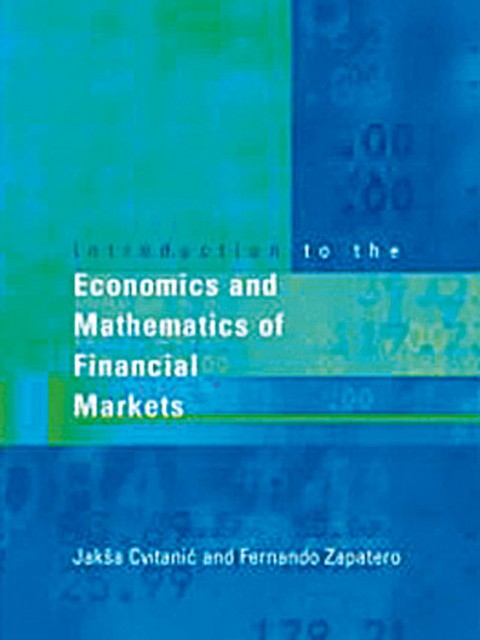
An important monograph Introduction to the Economics and Mathematics of Financial Markets, by Jakša Cvitanić and Fernando Zapatero, MIT Press, 2004.

| 15. siječanj 2009.| Ana Blašković Cvitanić: Financijski derivati mogu biti korisni za nelikvidna tržišta Jakša Cvitanić, profesor na Caltechu i predavač na Dubrovačkoj školi bankarstva i financija govori o financijskim izvedenicama i uzrocima krize S prvim danom 2009. na snagu je stupila nova legislativa za tržište kapitala čime je postavljen pravni okvir za trgovinu financijskim izvedenicama na domaćem tržištu. Iako su financijaši prije krize usrdno navijali za njihovo uvođenje, danas zahvaljuju što derivati nisu zaživjeli jer bi, smatraju, s njima kriza bila daleko gora. O derivatima i njihovoj povezanosti s krizom razgovarali smo s Jakšom Cvitanićem, profesorom financijske matematike na elitnom američkom sveučilištu California Institute of Technology. O derivatima se mnogo govori, a malo zna. Kakvi su to instrumenti? Životopis Split
|

Formated for CROWN by prof.dr. Darko Žubrinić
Distributed by www.Croatia.org . This message is intended for Croatian Associations/Institutions and their Friends in Croatia and in the World. The opinions/articles expressed on this list do not reflect personal opinions of the moderator. If the reader of this message is not the intended recipient, please delete or destroy all copies of this communication and please, let us know!


