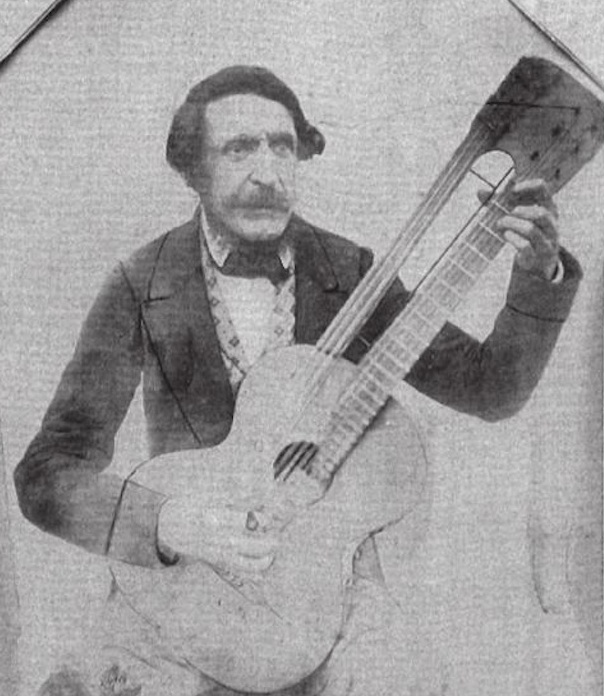
One of the greatest European guitarists of the mid 19th century
original plan in 1841 in Vienna. The photo was taken in his native town of Varaždin.
It is kept in the Museum of Arts and Crafts in Croatia’s capital Zagreb, as well as the guitar.

Introduction et variations sur le Choeur d’Introduction de NORMA pour Guitarre Seule remplies
et dediees a Monsieur J. V. de Bobrowicz par Jean Padovetz
(translation from French: Introduction and variations of NORMA for Solo Guitar fulfilled
and dedicated to Mr. J. V. de Bobrowicz by Jean Padovetz).
It is interesting that the Polish guitarist Bobrowitz, who was a student of Mauro Giuliani,
in return dedicated one of his guitar pieces to Ivan Padovec.

Theoretisch-praktische Guitar-Schule vom ersten Elementar Unterrichte an bis zur
vollkommene Ausbildung nebst der Anweisung zum Spiele einer zehnsaitigen Guitare von Johann Padowetz
(Guitar school by Johann Padowetz for his ten string guitar, published in Vienna in 1842 in German, 31 pp).
Source of the photos is Mirko Orlić: Ivan Padovec, hrvatski gitarist europskog ugleda [PDF], Gitara 2, 2000.
Johann Padowetz (1800-1873): Premier Concertino in C major, for guitar and strings
Allegro moderato, Andante, Rondo, Allegretto
Darko Petrinjak, guitar
The Rucner String Quartet
Johann Padowetz (1800-1873) – Die Sehnsucht (La nostalgie / Nostalgia)
Michel Démarez, guitar / guitare & arrange(u)r
Jean Cassignol, soprano recorder / flűte ŕ bec soprano
June 8 / 8 juin, 2012, Survilliers (France) Saint-Martin Church / Eglise Saint-Martin
Johann Padowetz (1800-1873): Second Concertino in F major, for guitar and strings
Allegro moderato, Andante sostenuto, Polacca
Darko Petrinjak, guitar
The Rucner String Quartet
| Ivan Padovec Rođen u Varaždinu, gitarist i skladatelj Ivan Padovec (1800./1873.) u gitari je bio samouk, dok je glazbenu teoriju učio u Zagrebu kod Jurja Karla Wisner Morgensterna. Od 1829. do 1837. godine djelovao je u Beču. Kao jedan od posljednjih europskih gitarista svojega doba s velikim je uspjehom koncertirao u domovini i inozemstvu (Beč, Graz, Prag, Brno, Budimpešta, Frankfurt na Majni, Hannover, Hamburg, London i dr.). Pisao je skladbe za gitaru, najviše varijacije i fantazije na popularne operne teme. U svojim se vokalnim djelima, solo pjesmama uz gitaru ili klavir, uspješno približio duhu hrvatske narodne pjesme. Mnoge Padovčeve skladbe izdao je nekad poznati bečki nakladnik A. Diabelli. |
Ivan Padovec Guitarist and composer Ivan Padovec (1880-1873) was born in Varaždin, Croatia. Juraj Karl Wisner Morgenstern passed his music theory knowledge on I. Padovec in Zagreb. From 1829 to 1837 Ivan Padovec played in Vienna. As one of the last European guitarists of his time, he perfomed with great success at concerts in his homeland and abroad (Vienna, Graz, Prague, Brno, Budapest, Frankfurt, Hannover, Hamburg, London, etc.). He wrote compositions for a guitar, mostly variations and fantasies on popular operatic themes. In his vocal works, solo songs with guitar or piano, he successfully approaches to the spirit of Croatian folk songs. Many Padovec’s compositions were released by once famous Viennese publisher A. Diabelli. |
Guitar: Darko Petrinjak
Vocal: Ruža Pospiš-Baldani
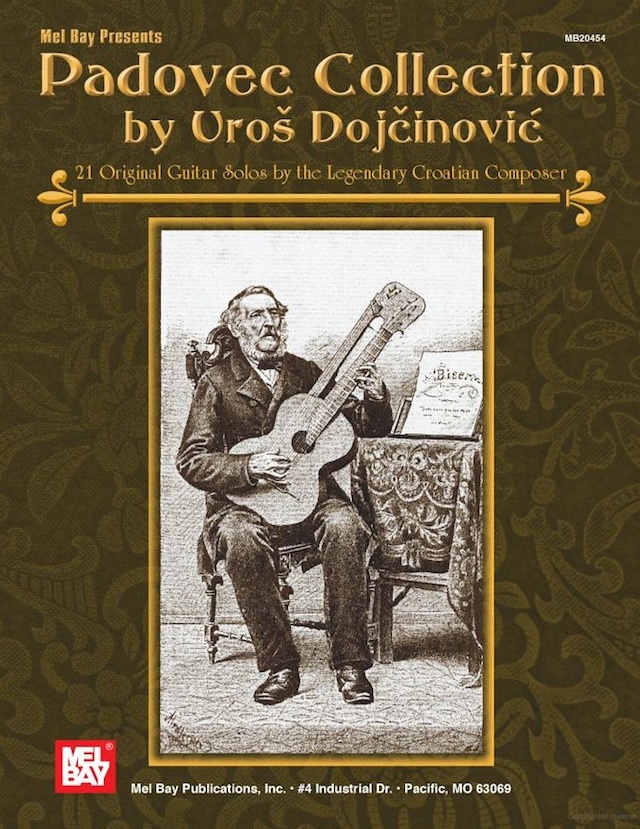
| Ivan Padovec 1800-1873 Ivan Padovec was born in Varaždin, Croatia in 1800. He was among the first professional Croatian guitarist/composers with an international reputation. He gave successful concerts both at home and abroad, and composed over 200 compositions, instrumental (mostly for one and two guitars) and vocal (songs for different voices accompanied by guitar or piano). Many of his compositions were published during his lifetime, by well-known publishers in Vienna, Prague, etc. But some of his works were kept in his, or his friends’ handwriting, like “Polonaise in La-major”, one of the most famous short Padovec pieces.  Ivan Padovec was blind at his older age
In addition to his concerts, Ivan Padovec wrote a great number of works, despite his poor eyesight. Paramount among his works is his 31-page pedagogic book Teoretische-practische Guitar-Schule which was awarded a First Prize of 40 ducats in a competition bearing the name of a Russian guitarist (probably Makarov). The guitar method was published in 1842 by the Viennese publisher Werner. Its eight chapters contain general musical instructions on the technique of playing the six-stringed guitar. The second part of the book consists of melodious pieces for practising, and the third part deals with playing the ten-stringed guitar. The ten-stringed guitar invented by Padovec had in addition to the usual six strings, four basses (D, C, B, and A) fastened by separate pegs, by which each string could be raised a semitone. The guitar was made for him by the famous Viennese luthier Stauffer. In 1837 Padovec performed in various towns in Poland. By then his eyesight was steadily weakening and he was obliged to abandon his tour to Russia, returning to Vienna. On the advice of his doctors, who were unable to cure him, he soon returned to his native Varaždin, where he stopped writing and reading for a while. By this means he began to recover. His eyesight improved enough that he was able to start giving lessons and occasionally to perform in Varaždin and nearby towns. After one of his great concerts in Zagreb in 1840, the magazine Danica recorded on January 18th:
In 1848 Padovec lived in the family house of his sister, facing financial problems. As he was now completely blind, he could neither compose nor teach. Despite this he still tried to make some music, which was dictated to his friends. Later, the scores were checked, corrected or rewritten by Ivan Udl, an organist from Varaždin, and Padovec’s friend. At the end of his life Padovec lived in great poverty. He did receive some financial support, but this was insufficient. The published contents of the greatest Croatian XIX century guitar composer and performer, Ivan Padovec’s, complete biography, collection of all known photos, and unpublished solo pieces without opus numbers. They range from his more-easy, short didactic compositions, done for his numerous guitar students, to a number of miniatures, dances and themes, with variations of a medium technical difficulty, and finally a few pieces for more advanced players. The entire collection is based on the music, which for more than 120 years was totally unknown outside of Padovec’s country, Croatia, and mostly lost or forgotten and never published. Presents biographical notes, as well as Padovec’s portraits and other illustrations, with all pieces found in his own manuscript or handwriting of his closest pupils and friends. They are the result of more than 25 years of Mr. Dojcinovic’s research. This is the first collection of Padovec’s music ever to be published! |
Mirko Orlić: Ivan Padovec, hrvatski gitarist europskog ugleda [PDF], Gitara 2, 2000.
Josip Bažant: Gitarist Ivan Padovec [PDF], 2000., novi doprinosi za monografiju
Johann Padowetz (1800-1873)
Darko Petrinjak, guitar
| The Croatian musician Darko Petrinjak graduated in double-bass from the Academy of Music in Zagreb, as well as in guitar and lute from the Royal Academy of Music in London. He made a successful career as a soloist and chamber musician, and in 1984 he founded the renowned Zagreb Guitar Trio. He has given guest performances all over the world, and he is also active as a jury member at international guitar competitions and a masterclass teacher. His extensive repertoire gives a prominent position to the Croatian composers and many of them have dedicated their compositions to this musician. He taught at the Birmingham School of Music, and since 1982 he has been teaching at the Music Academy in Zagreb. |

Johann Padowetz (188-1873): Deux polonaises Op.3
Polonaise Op.3 No.1, Polonaise Op.3 No.2
Darko Petrinjak & Maroje Brčić, guitars
Piano: Mira Flies-Šimatović, Vocal: Josip Novosel
Johann Padowetz (1800-1873): Der Carneval von Venedig mit concertanten Variationen für zwei Guitaren
(The Carnival of Venice with concert variations for two guitars)
Darko Petrinjak, I. guitar, Maroje Brčić, II. guitar

Ivan Padovec: Variazioni op. 16, Accademia di Romania, Roma, 16.01.2004
Goran Listeš, guitar
|
Johann Padowetz – Polonaise in A-major, for solo guitar (2:39)
Johann Padowetz – Mazurka, for solo guitar (1:43) Johann Padowetz – Der Carneval von Venedig mit concertanten Variationen, Op.62, for two guitars (6:55) Johann Padowetz – Deux polonaises, Op.3 No.2, duet for terz and ordinary guitar (3:37) Johann Padowetz – Deux polonaises, Op.3 No.1, duet for terz and ordinary guitar (3:49) Johann Padowetz – Moderato, for solo guitar (1:04) Johann Padowetz – March, for solo guitar (2:23) Performing artists: Darko Petrinjak, Maroje Brčić Source www.unsungcomposers.com |


The house in which Ivan Padovec, Croatian composer and artist, was born and died.
Placed in 1900, on the occasion of centennial of his birth, by the Croatian singing society “Fairy”.

The street of Ivan Padovec in Varaždin.

The grave of Ivan Padovec in Varaždin.
The city of Varaždin
Distributed by www.Croatia.org . This message is intended for Croatian Associations/Institutions and their Friends in Croatia and in the World. The opinions/articles expressed on this list do not reflect personal opinions of the moderator. If the reader of this message is not the intended recipient, please delete or destroy all copies of this communication and please, let us know!


