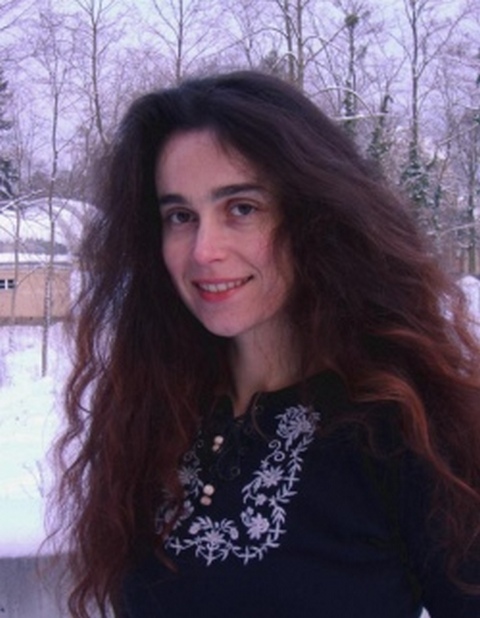
Co-discoverer of an Earth-like planet outside the Solar system using gravitational lensing
Physics department, University of Rijeka, Omladinska 14, 51000 Rijeka, Croatia
| Dr. Dijana Dominis Prester participated in the discovery of the first planet outside of Solar system In Science magazine, within the Editor’s choice, a news item was published in 2006 about a discovery of the first extrasolar planet (that is, of a planet outside of Solar system) in which a group of astrophysiscist participated from all 6 continents, among them a Croatian scientist, Dijana Dominis Prester from the University of Rijeka Department of Physics. The planet is named OGLE 2005-BLG-390L. The complete scientific paper has been published in the magazine Astrophysical Journal 741, 22. Source University of Rijeka Reference: J.-P. Beaulieu, D.P. Bennett, P. Fouque, A. Williams, M. Dominik, U.G. Jorgensen, D. Kubas, A. Cassan, C. Coutures, J. Greenhill, K. Hill, J. Menzies, P.D. Sackett, M. Albrow, S. Brillant, J.A.R. Caldwell, J.J. Calitz, K.H. Cook, E. Corrales, M. Desort, S. Dieters, D. Dominis, J. Donatowicz, M. Hoffman, S. Kane, J.-B. Marquette, R. Martin, P. Meintjes, K. Pollard, K. Sahu, C. Vinter, J. Wambsganss, K. Woller, K. Horne, I. Steele, D. Bramich, M. Burgdorf, C. Snodgrass, M. Bode (PLANET) A. Udalski, M. Szymanski, M. Kubiak, T. Wieckowski, G. Pietrzynski, I. Soszynski, O. Szewczyk, L. Wyrzykowski, B. Paczynski (OGLE), the MOA Collaboration, 2006, Discovery of a Cool Planet of 5.5 Earth Masses Through Gravitational Microlensing, Nature, 439, 437-440 |
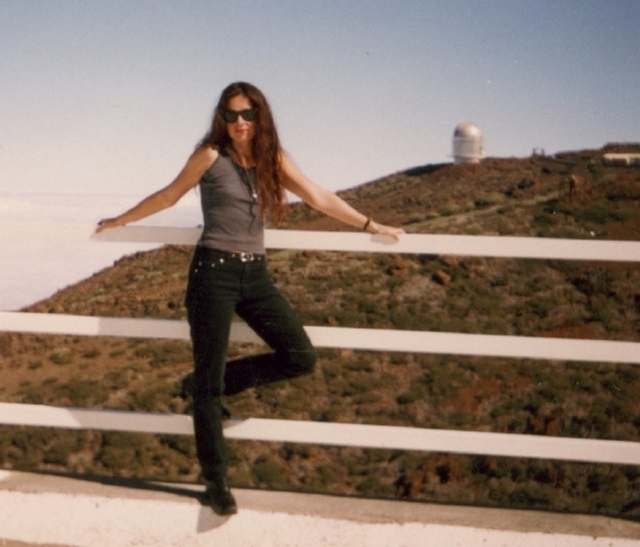
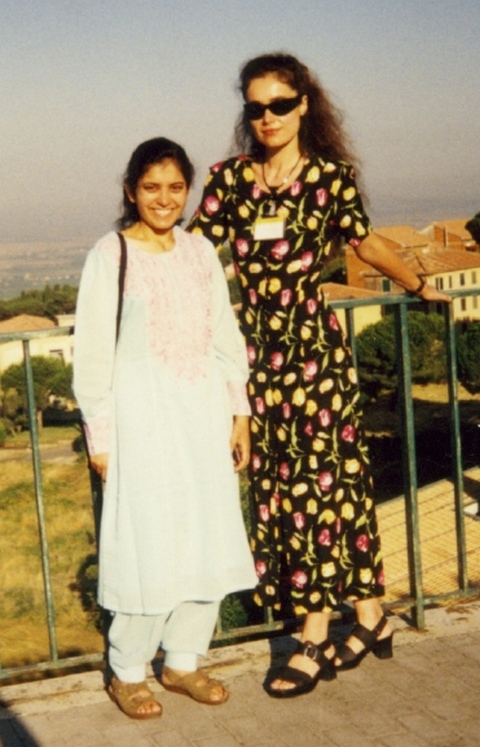
| Dr. Dijana Dominis Prester
Source www.aip.de/~dijana |
|
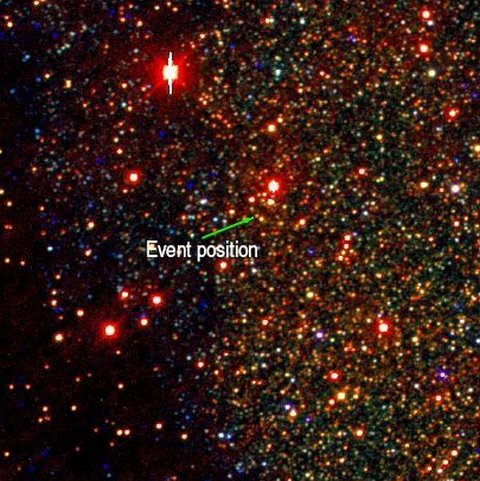
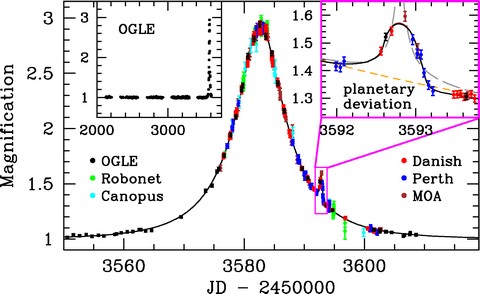
First cool extra-solar planet discovered By means of the microlensing technique a small “cool” planet was discovered (the discovery is reported in the current issue of “NATURE”). The newly discovered planet with the technical name OGLE-2005-BLG-390Lb is only about 5.5 times as massive as Earth. Thus it resembles Earth more than any of the so-far-known 170 exoplanets. It circles its parent star in about 10 years and in a distance that is 3 times the distance between Sun and Earth. Its parent star is a red dwarf that amounts to 20% the size of the Sun. Thus it is probably the least massive exoplanet around an ordinary star. Due to its weak parent star and the huge distance the planet receives only about 0.1% of the energy we receive from the Sun. Its surface temperature with estimated ~50 Kelvin (-220° Celsius) and its mass indicate a rocky or icy surface (contrary to gas giants like Jupiter or Saturn). Its discovery marks a huge success in the search for planets that support life. The planet was discovered by using the microlensing technique which is based on a prediction by Einstein: light beams are attracted due to the gravitation of other stellar bodies and are thus distracted from their straight direction. However, this effect is in most cases incredibly small. But if a dim, intervening star can be used as a giant natural telescope, the more distant star can be magnified and temporarily looks brighter. The exact process of becoming symmetrically brighter and darker is mathematically well documented. If this brightened star is no single star but is accompanied by a planet this symmetrical “light curve” shows a short deviation with a further maximum. Thus the planet, although it cannot be seen from Earth, can be recognized. The distance of this extrasolar planet system is huge: it is about 22,000 light years away from us. Thus a further examination of the planet is nearly impossible. Three independent microlensing campaigns were involved in the discovery: PLANET/RoboNet, OGLE and MOA. This includes 73 scientists at 32 institutes in 12 countries (Germany, France, Great Britain, Poland, Denmark, Austria, Chile, Australia, New Zeeland, USA, South Africa and Japan). Involved scientists from Germany are Dijana Dominis from the Astrophysikalische Institut Potsdam (AIP), Daniel Kubas from the Universität Potsdam, Joachim Wambsganss and Arnaud Cassan from the Zentrum fuer Astronomie der Universität Heidelberg (ZAH) as well as Martin Dominik. “Only good cooperation, coordination and strong dedication allowed this discovery after 10 years of research” explains Dominis.
OGLE-2005-BLG-390Lb is the third planet to be discovered by the microlensing technique. Different methods prefer different kinds of planets and stars which exist in different abundances. The relatively low yield is due to the fact that the microlensing effect favours gas giants like jupiter around red dwarfs which can be discovered relative easily but are very rare. However, only two of the found planets are gas giants. The discovery of OGLE-2005-BLG-390Lb as the third planet indicates a relative abundance of planets which are lighter than the outer ice planets Uranus and Neptun. This confirms our theories of planet formation. These microlensing events are extremely rare: at most one among a million stars is enhanced by gravitation. Thus astronomers introduced a division of work: one group, the “OGLE team”, regularly measures the brightness of 10 million stars (about twice a week). If one of them shows a change in brightness characteristic for the microlensing effect, an “e-mail alarm” is send to interested scientists, last year there were 600 of them. The PLANET team specializes in regularly measuring these lense events, ideal is several times per hour in order to exactly determine the progress of the light curve and possible deviations. This can only be achieved by a combination of four telescopes in the southern hemisphere: Tasmania, Western Australia, South Africa and Chile. Thus it is guaranteed that this star is measured for 24 hours. Thereby the astronomers have a “24 hours night shift”: at any time it is night in one of these places!
Light curve of the microlens event OGLE-2005-BLG-390Lb where the planet caused a second maximum. The horizontal axis covers a period of 70 days; the magnified part in the upper right corner covers only 2 days. (Graph: PLANET group) On August 10, 2005 it happened: the microlensing event OGLE-2005-BLG-390 showed a short deviation when it went back to its normal brightness. So far it had scarcely deviated from its maximum which was 3 times above normal. This second maximum exactly progressed as is expected from a planet. However, it lasted only 15 hours. The considerably deviating break points were confirmed by 5 different observatories: the result was real. The analysis and modelling of the dates yielded only one result: a companion of the main lens star which has only 0.00008 as much mass is responsible. No other possibility could explain these data.
Since the lens star itself is too weak to be seen directly its mass cannot be measured exactly: it is probably between 10% and 40% of the mass of the Sun whereby the most probable value is 20%. Thus the most probable value for the planet mass is 5.5 times the mass of the Earth. The distance of the planet to its parent star is about 2.6 times the distance between Earth and Sun. thus it needs about 10 Earth years for one revolution. Most of the so far known 170 planets around distant Suns have high masses (comparable to the one of Jupiter) and orbit their parent stars very closely. Thus they are called “hot Jupiters”. Actually the astronomers had expected many planets with smaller masses (“rock or ice planets”) and greater distances. The particular importance of this discovery is the fact that the planet has the lowest mass from all known exoplanets. Thus it is the one most similar to Earth. Probably it is an icy or rocky planet resembling Earth, Venus and Mars. Astronomers think that this planet type should be much more common than the “hot Jupiters”. OGLE-2005-BLG-390-Lb is the third planet found by means of the microlensing method: the masses of the previously found planets were slightly above Jupiter. Like for all methods, it is easier to find bigger planets. The fact that already one among three discovered planets has such a low mass indicates that they are much more common in our Milky Way. The team leader, Dr Jean-Philippe Beaulieu from the Institut d’Astrophysique de Paris demands an expansion of the search with the microlensing effect with existing or additional ressources from Earth – or in the near future from a satellite: “The discovery of a rocky or icy planet which is lighter than Neptun or Uranus is a clear hint that more such planets will be discovered which is the first step to discovering another Earth”. Contact Dijana Dominis New address of dr. Dijana Dominis Prester in the city of Rijeka, Croatia Dr. Daniel Kubas Prof. Joachim Wambsganß Source www.aip.de/highlight_archive/dominis_microlensing |




|
MOA-2009-BLG-387Lb: A massive planet orbiting an M dwarf
Virginie Batista1,2, A. Gould3,4, S. Dieters1,2, Subo Dong3,5,6, I. Bond7,8, J.P. Beaulieu1,2, D. Maoz3,9, B. Monard3,10, G.W. Christie3,11, J. McCormick3,12, M.D. Albrow1,13, K. Horne1,14,15, ,Y. Tsapras1,14,66,67, M.J. Burgdorf16,62,63, S. Calchi Novati16,69,71,70, J. Skottfelt16,17, J. Caldwell1,19, S. Koz3owski4, D. Kubas1,2,20, B.S. Gaudi3,4, C. Han3,21, D. P. Bennett1,7,22, J. An81
and F. Abe23, C.S. Botzler24, D. Douchin24, M. Freeman24, A. Fukui23, K. Furusawa23, J.B. Hearnshaw13, S. Hosaka23, Y. Itow23, K. Kamiya23, P.M. Kilmartin25, A. Korpela26, C.W. Lin8, .H. Ling8, S. Makita23, K. Masuda23, Y. Matsubara23, N. Miyake23, Y. Muraki27, M. Nagaya23, K. Nishimoto23, K. Ohnishi28, T. Okumura23, Y.C. Perrott24, N. Rattenbury24,14, To. Saito29, D.J. Sullivan26, T. Sumi23, W.L. Sweatman8, P.J. Tristram25, E. von Seggern24, P.C.M. Yock24 (The MOA Collaboration), and S. Brillant20, J.J. Calitz30, A. Cassan2, A. Cole31, K. Cook32, C. Coutures33, D. Dominis Prester34, J. Donatowicz35, J. Greenhill31, M. Hoffman30, F. Jablonski37, S.R. Kane38, N. Kains14,15,61, J.-B. Marquette2, R. Martin39, E. Martioli37, P. Meintjes30, J. Menzies40, E. Pedretti15, K. Pollard13, K.C. Sahu41, C. Vinter17, J. Wambsganss42,16, R. Watson31, A. Williams39,82, M. Zub42,43 (The PLANET Collaboration), and W. Allen44, G. Bolt45, M. Bos46, D.L. DePoy47, J. Drummond48, J.D. Eastman4, A. Gal-Yam49, E. Gorbikov9,51, D. Higgins50, J. Janczak4, S. Kaspi9,51, C.-U. Lee52, F. Mallia53, A. Maury53, L.A.G. Monard10, D. Moorhouse54, N. Morgan4, T. Natusch55, E.O. Ofek56,57, B.-G. Park52, R.W. Pogge4, D. Polishook9, R. Santallo58, A. Shporer9, O. Spector9, G. Thornley54, J.C. Yee4 (The μFUN Collaboration), and V. Bozza69,71,70, P. Browne15, M. Dominik15,72, S. Dreizler73, F. Finet74, M. Glitrup75, F. Grundahl75, K. Harpsoe17, F.V. Hessman73, T.C. Hinse17,76, M. Hundertmark73, U.G. Jorgensen17,18 , C. Liebig15,42, G. Maier42, L. Mancini69,70,80, M. Mathiasen17, S. Rahvar77,79, D. Ricci74, G. Scarpetta69,71,70, J. Southworth78, J. Surdej74, F. Zimmer17,42 (The MiNDSTEp Consortium) A. Allan59, D.M. Bramich1,61,C. Snodgrass16,20,65,I.A. Steele60,R.A. Street67,68 (The RoboNet Collaboration) Aims. … Here we present the analysis of the microlensing event MOA-2009-BLG-387, a resonant-caustic event, which we demonstrate is caused by a massive planet orbiting an Mdwarf. The light curve associated with this event contains very prominent caustic features that are well separated in time. These structures were very intensively monitored by the microlensing observers, so that the geometry of the system is quite well constrained. As a result, the event has high sensitivity to two higher order effects: parallax and orbital motion of the planet. |

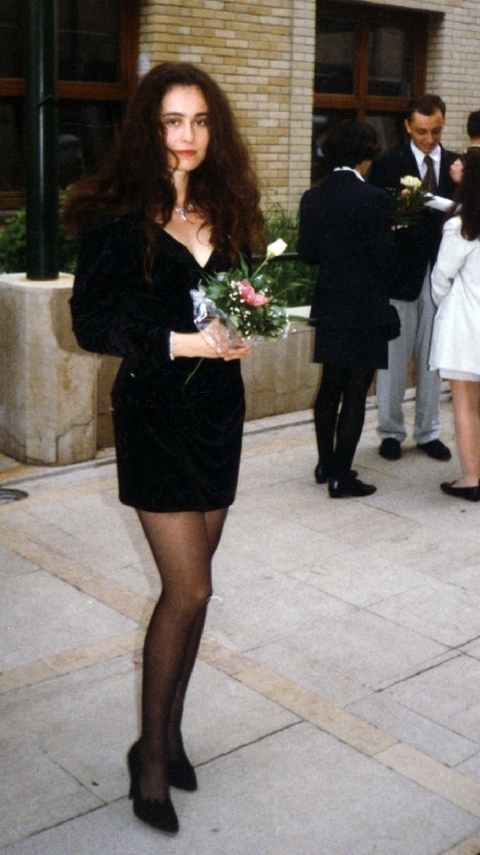
 Predavanje doc.dr.sc. Dijane Dominis Prester sa Odjela za fiziku Sveučilišta u Rijeci održano 16.12.2010. u Astronomskom centru RIjeka u organizaciji Akademskog astronomskog društva Rijeka na temu kolaboracije MAGIC koja koristi metode detekcije gama zraka pomoću Čerenkovljevih teleskopa smještenih na La Palmi. |
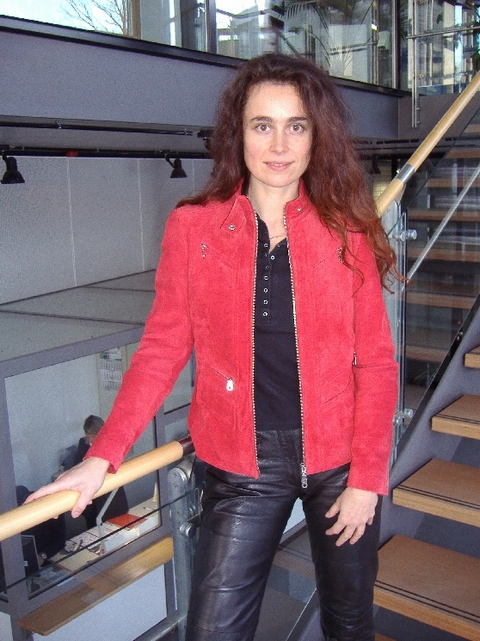
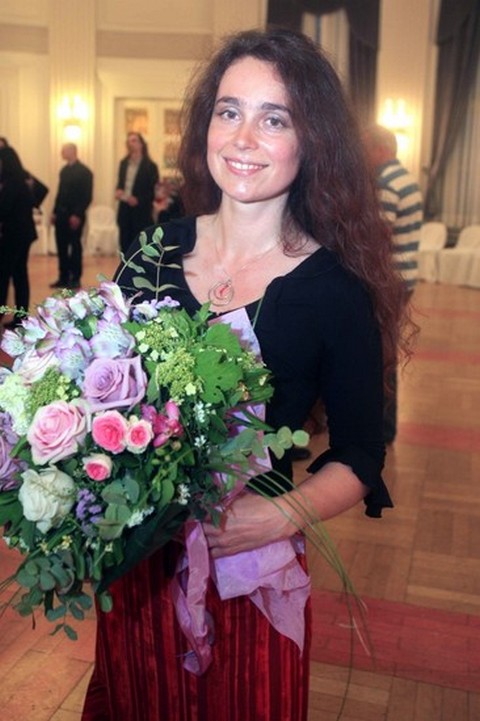
Dr. Dijana Dominis Prester in Zagreb.
Photo by Tomislav Smoljanović.
Distributed by www.Croatia.org . This message is intended for Croatian Associations/Institutions and their Friends in Croatia and in the World. The opinions/articles expressed on this list do not reflect personal opinions of the moderator. If the reader of this message is not the intended recipient, please delete or destroy all copies of this communication and please, let us know!


