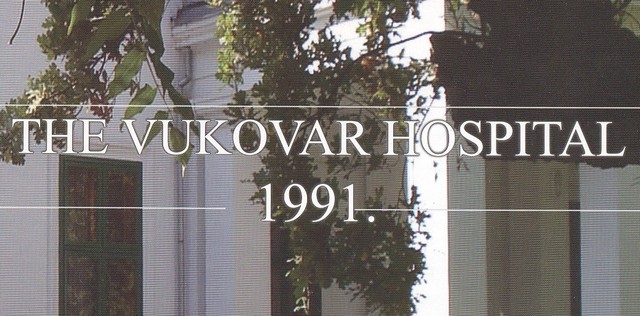
The Vukovar Hospital in 1991
|
Thomas Burns: Vukovar road to recovery (audio below)
|
 |
The English edition of the monograph was published in 2008 by the Vukovar Hospital and “Society of the Croatian doctors and volunteers in 1990-1991”. Its Organizer council consists of Dr. Vesna Bosanac, Dr. Juraj Njavro, and Dr. Štefan Biro. Especially important is an article by professor Andrija Hebrang, entitled: Silence of the International humanitarian organizations about the tragedy of the Vukovar Hospital. The Vukovar Hospital 1991, published in Vukovar 2008., ISBN 978-953-55455-0-7 The monograph is the English translation of earliear edition published in Croatian under the title Vukovarska bolnica 1991. The Croatian edition was published in Vukovar in 2007. The book has A4 format and 385 pp, accompanied with numerous photos, many of them in color. Each page of the book is nicely decorated with the motive from the famous Baška Tablet (on the left), which contains Croatian Glagolitic letters carved around 1100. The introductory part contains unforgettable Story about the city by Siniša Glavašević, a legendary Croatian newspaperman, who himself was a victim of the aggression on Vukovar, murdered in a mass grave with 200 other victims by the end of 1991. 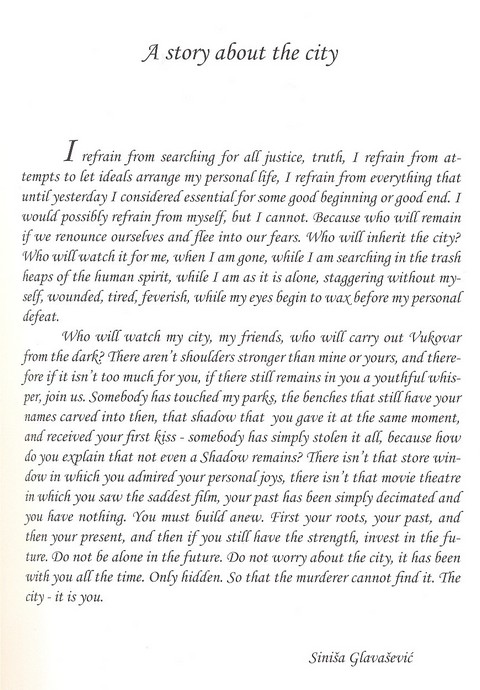  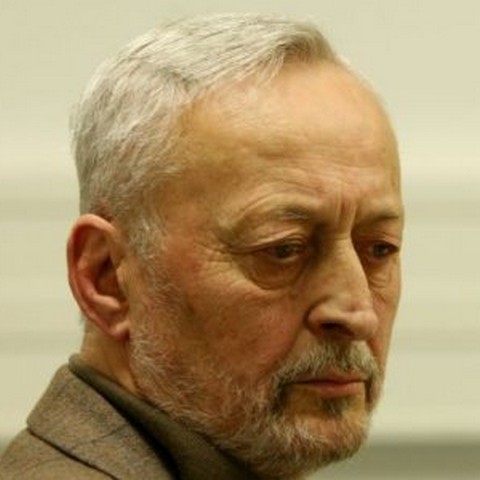 Dr. Juraj Njavro (1938-2008), one of the editors of the monograph “The Vukovar Hospital 1991”
The book is in fact a collection of articles dealing with the Vukovar Hospital.  Professor Andrija Hebrang
In his article he pointed out that many questions related to the tragedy of Vukovar remained without answer. According to Andrija Hebrang the 1991 Vukovar tragedy passed unnoticed and without any reactions of the International community. Preserved documents prove that that International observers (The European Mission, Red Cross, Doctors Without Borders – Medicins sans Frontiere) were witnesses of bestialities of the Serbian soldiers on the wounded persons and civilians during the occupation of the Vukovar Hospital, and they did not inform the world public about that. Professor Hebrang concludes that it was easier to conceal the truth then to proclaim the crime, and therewith also help the agressor realize their aims. See pp. 251-253.
I Old Vukovar – Health care in Old Vukovar, 1-89 Vlado Horvat: Vukovar in the middle of the 19th century Štefan Biro described the history of medicine in Croatia and the history of the Vukovar Hospital until 1991 in the series of forteen articles II The Croatian War of Independence Vesna Bosanac: – Role and importance of the Vukovar Hospital during the Croatian War of Independence, – Beginning of the agression on Vukovar and the structure of the hospital, – Cooperation of the war hospital of Vukovar with other relevant institutions for the Vukovar defense, – War shelters in Vukovar, – Injuries and suffering of the civilians, – Cooperation with internation organizations, – Hardest period for the Vukovar Hospital, Juraj Njavro and Zoran Aleksijević: – The war medical service – role and importance of the surgery Ivan Medved: – Role of the Main medical headquarter at the Ministry of Health Ivica Kostović: – Humanitarian crises in Vukovar during the Croatian War of Independence Boris Kratofil and Stanko Kušt: – War anesthesiology in Vukovar during the Croatian War of Indepdence Edin Zujović: – Transfusion medicine in the Vukovar Hospital 1991, “Man to man life” Vladimir Horvatić: – Ambulance services during the aggression and occupation of Vukovar Štefan Biro: – Organization and activities of the stomatological services during aggression on Vukovar in 1991 Binazija Kolesar and Agnezija Aleksijević: – Nurses in the Vukovar Hospital Štefan Biro: – The hospital logistics in the system of War Hospital Vukovar in 1991 Vladimir Emedi: – Outer station of the Vukovar Hospital, – Temporary hospital “Borovo-Commerce” Jakob Grof Eltz Vukovarski and Josip Husar: – Blocades of Vukovar in 1991, – Care and evacuations of the wounded persons Vesna Bosanac: – Evacuations of the wounded from the Vukovar Hospital, – Testifying about the last days in the Vukovar Hospital Binazija Kolesar: – Evacuations of the wounded and personnel from the War Hospital Vukovar Štefan Biro: – The agony of Vukovar – The convoy with the wounded Vladislav Nadaš: – War memories of a doctor Vesna Bosanac and Davor Bandić: – Children in war Andrija Hebrang: – Silence of the internationl humanitarian organizations about the tragedy of the Vukovar Hospital – Incompetence or politics? III Exile, reintegration and return, 258-334 Vesna Bosanac and Štefan Biro: – Vukovar Helath care in the exile J. Kiš, L. Kuruc, J. Dolanski, M. Kasić, V. Bosanac and Š. Biro: – War Hospital Old Mikanovci – Medical service o fthe 10th Home guard regiment Zlatko Šimunović and Štefan Biro: – Structure of the Vukovar health cares in the exile, The National Health Institute Marijana Mihaljević, Vesna Bosanac and Štefan Biro: – Peaceful reintegration of the helath care in Vukovar and in the Croatian Danube basin Vesna Bosanac: – Vukovar Hospital now and in the future … (we skip the titles of 18 articles) IV In memoriam, 341-381 Marijana Ivančić: – Memories Suzana Horvat: – My war memories Zoltan Konjetić: – Memories of a soldier Members of the War Hospital Vukovar Employees of the War Hospital muredred, tortured and missing We want to draw the attention of the reader especially to pp 195-253, dealing with events related to the tragedy of the Vukovar Hospital. On p. 211 we can find facsimiles of the agreement from the City Hospital of Vukovar:
On November 18, contrary to the agreement, shelling of the town continued.
On p. 253 we can see another facsimile of another dramatic document, addressed to European Commission in Hotel I in Zagreb. It was written and signed by Dr. Vesna Bosanac on November 11 2009, with request to be translated into English and sent to Mr. Wijnsents, Mr. Koll, Lord Carrington, Mr. Majer, Mr. Van den Bruck, Mr. Genscher, and to the Ministry of foreign affaires of the Netherlands. The document mentioned continuous attacks aiming to destroy the hospital by artillery and airplanes. And the hospital, situated in the cellar, had among others new born babies, their mothers, wounded children, and women civilians. Because of continuous attacks there were no water supply and medicins. Every moment new wounded were arriving. In the name of basic principles of humanity she implored cease fire and deblocade of the city of Vukovar.
Four employees of the Vukovar Hospital that were detained druging the Serbian occupation of the city in 1991, and whose destiny is still not known, are:
Twelve identified employees of the Vukovar Hospital, assasinated or victims of the 1991 aggression:
In conclusion, there are altogether thirty two (32) employees of the Vukovar Hospital, victims of the Serbian aggression on the city, and four detained employees whose destiny is unknown. The list of 20 children killed and murdered during the Serbian siege of of the city of Vukovar can be seen on p 237:
Three of them have been murdered at the Ovčara mass grave: Tomislav Baumgertner, Vedran Galić, and Igor Kačić. Also included is the list of 51 wounded children with description of wounds in Latin langauge and the date when they were wounded. Four children were missing or imprisoned. See pp. 235-237. The Vukovar Hospital took care of about 4000 people during the Serbian 1991 aggression, until November 20th, 1991. About 2250 people underwent difficult and long term operations. Each day approximatly 700 (seven hundred) granades was falling on the building of the hospital. The work of medicinal staff was going on in extremely difficult conditions, often without necessary equipment, even without electricity, food and water, in the celler and atomic shelter of the hospital, since the building was totally destroyed. In 1997 the hospital was reintegrated into the medical system of the Republic of Croatia, and in 1998 its complete renewal was started. For information about pourchasing the book please contact Mrs. Jasmina Jelisavac, Opća bolnica Vukovar (The Vukovar Hospital), secretary of Dr. Vesna Bosanac tel. +385 32 452 011 Dr. Vesna Bosanac e-mail: ravnatelj@ob-vukovar.hr Opća bolnica Vukovar (The Vukovar Hospital) www.ob-vukovar.hr |


| Nikola Knez: Operation Storm Croatian Film Institute Operation Storm was the single-most decisive battle of the Croatian War for Independence. Launched by the Republic of Croatia in August 1995, it was the largest European land battle since the Second World War. The success of this remarkable military action by Croatia came after four years of brutal fighting. Outnumbered, outgunned, but not outmaneuvered, this tiny new democracy prevailed in a David versus Goliath battle, a moral as well as military victory by an exceptional people. Storm ended the massive humanitarian disaster and genocide committed by the Serbian Army and Chetnik terrorists. It led to the liberation of one third of Croatian territory seized by the enemy, and it made possible the Dayton Agreement that brought peace to the region. This film documents the events surrounding this extraordinary battle, demonstrating that Croatia, along with its army and generals, deserve commendation from the world community, if not a Nobel Peace Prize. Operacija Oluja poznata je kao jedinstvena i odlučna bitka Hrvatskog naroda u borbi za nezavisnost. Oluja koju je Republika Hrvatska pokrenula u mjesecu kolovozu 1995, označena je kao najveća europska kopnena vojna operacija nakon Drugog svjetskog rata i opravdano je postala krunski dragulj hrvatskog Domovinskog rata. |
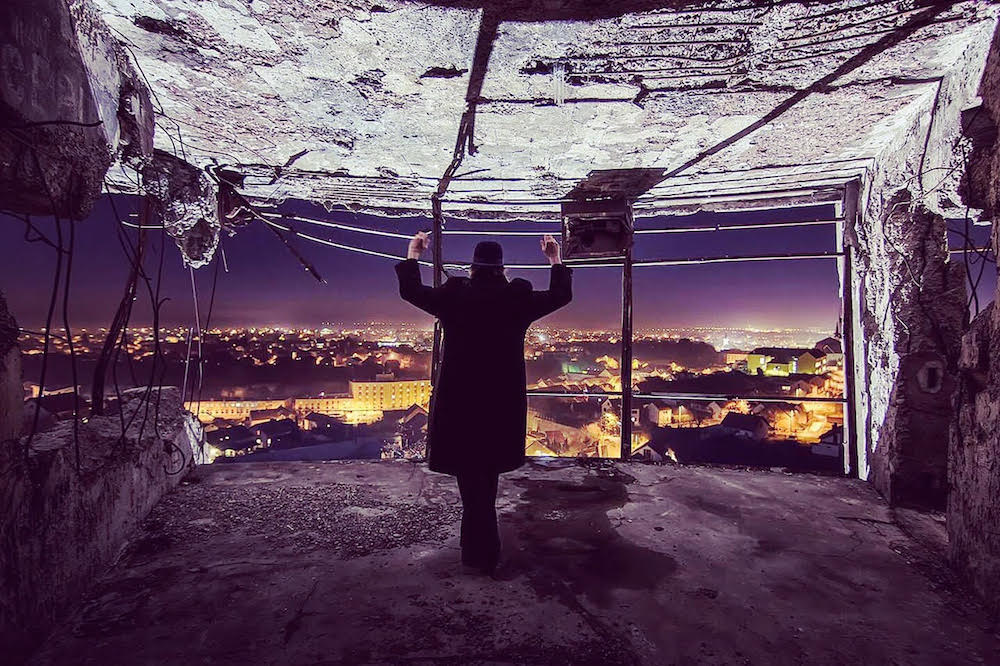
tormented Baroque city of Vukovar on the Danube river, December 2016. Photo by Vanja Vidaković.
| In December 2016 Nenad Bach visited the city of Vukovar as a representative at the State Office for Croatians Abroad. The members of the State Office had the opportunity to discuss various issues of vital importance for Croatia with President Kolinda Grabar Kitarović, as well as with Prime Minister Andrej Plenković. He also met legendary Dr. Vesna Bosanac, director of the famous Vukovar Hospital. |
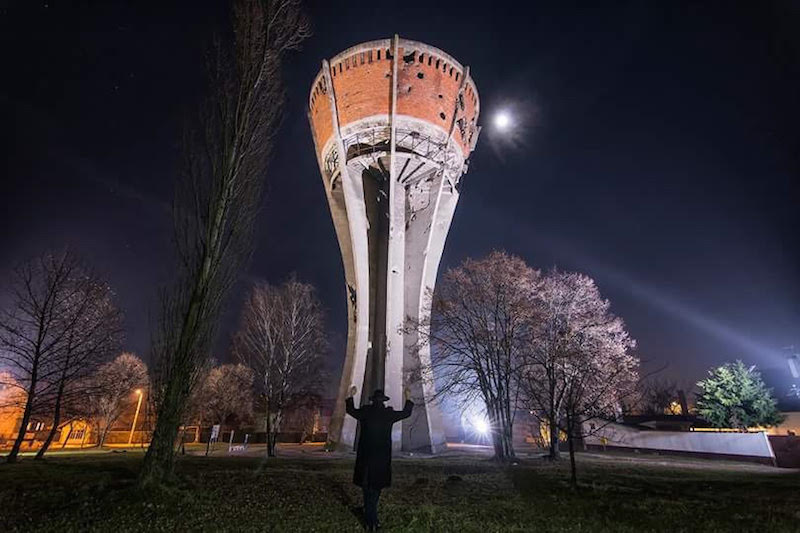
The Vukovar Water Tower (50 m high). Photo by Vanja Vidaković.
Drago Štambuk: Croatia
| CROATIA, London, 1991. Drago Štambuk: tekst, skladba, izvedba Arsen Dedić: aranžman Orkestar HRT-a (HRT = Croatian Radio Television)
Translated into Croatian by Dr. Drago Štambuk (the author of verses and music, and the singer)
Dr. Drago Štambuk, liječnik, pjesnik i diplomat, autor je teksta i glazbe za skladbu Croatia, koju napisao u Londonu, na engleskom, neposredno prije pada hrvatskoga grada heroja – Vukovara. Skladba nije nikada do sada, na pravi način, prezentirana javnosti, pa je trenutak da se ispravi nepravda prema pjesmi koja obogaćuje prostor vukovarske osjećajnosti. Uz Dan pada Vukovara, 18. studenoga 1991.
Nives Gajdobranski Many thanks to Dr. Drago Štambuk (a Fellow of Croatian Academy of Sciences and Arts in Zagreb) for sending us this information. |